Thursday, December 11, 2014

Preach this to yourself: No condemnation

If we would prevent gospel amnesia in our own lives, we should preach the gospel to ourselves -- including its benefits.

One of these glorious benefits is described by the apostle Paul: "Therefore there is now no condemnation for those who are in Christ Jesus" (Rom. 8:1, NASB).

This means God does not condemn those of us who have trusted in Jesus to save us from our sins. It is not that we will be condemned if we don't embrace the gospel of Christ. It is that we have been rescued from the condemnation we already were experiencing. Paul teaches this truth in other passages, and Jesus testifies to it.

In Rom. 5:18, Paul writes: "So then as through one transgression there resulted condemnation to all men, even so through one act of righteousness there resulted justification of life to all men." Our condemnation was the result of the sin of one man, Adam. As his descendants, we are under condemnation.

In Eph. 2:3, Paul says, "[We] were by nature children of wrath, even as the rest." God's wrath was upon us just by virtue of being human beings with a sinful nature.

John 3:17-18 is a great Christmas passage in which God the Son explains a reason He came to earth as a man -- and points to the condemnation all humanity lives under. He says, "For God did not send the Son into the world to judge the world, but that the world might be saved through Him. He who believes in Him is not judged; he who does not believe has been judged already, because he has not believed in the name of the only begotten Son of God."

As sinners by nature, we are condemned; we are under wrath; we are judged. That all changes when God saves us by His grace because of the powerful gospel work of His Son. Now, we are no longer under condemnation -- forever. Nothing can reverse that verdict.

That is the kind of benefit we should regularly remind ourselves of. At Christmas, we can remember -- God the Son came to deliver us from the condemnation that dominated us. That is cause for rejoicing in Jesus and His gospel.

* -- Photo source.

Sunday, December 7, 2014

Second Sunday of Advent: He came as a baby

'4. Advent' photo (c) 2011, Barbara - license: http://creativecommons.org/licenses/by-nd/2.0/(This is the second in a four-part series that seeks to help Christians observe Advent, that season celebrating the coming of our Savior and leading to Christmas Day. This series is designed for use on each Sunday of Advent, but it can be used at any point.)

It is a story that could only be described as myth or fable except that it is recorded in the perfect Word that has the perfect God as its author: The Creator of the cosmos becomes a man. Even more stunning, He does not take on flesh as a full-grown human being. He becomes human the way all humans do -- by conception -- with one all-important difference: He has no earthly father.

The God who has made and regulates all things becomes an embryo. Early -- really early -- in His gestation, another unborn child and his mother recognize He is the long-awaited Messiah (Luke 1:39-45). In a virgin's womb, He matures as other unborn children do. His body takes shape and grows until the nine months of pregnancy come to their end, and His humble mother delivers Him in a humble location. He arrives in the outside world through the labor and pain of a young mortal.

As J.I. Packer wrote in his book Knowing God:
[T]he Almighty appeared on earth as a helpless human baby, unable to do more than lie and stare and wriggle and make noises, needing to be fed and changed and taught to talk like any other child. And there was no illusion or deception in this: the babyhood of the Son of God was a reality. The more you think about it, the more staggering it gets. Nothing in fiction is so fantastic as is this truth of the incarnation.
Yet, this same person who humbled Himself to become an embryo and to die a criminal's death as a man is the One whose exaltation to the highest place is assured. Phil. 2:9-11 describes God the Father's elevation of His Son this way:
For this reason also, God highly exalted Him, and bestowed on him the name which is above every name, so that at the name of Jesus every knee will bow, of those who are in heaven and on earth and under the earth, and that every tongue will confess that Jesus Christ is Lord, to the glory of God the Father.
This is the story of Christmas -- a baby born in a Middle Eastern town is Lord of all.

Here is "Gather 'Round, Ye Children Come," a song by Andrew Peterson that fits with the theme of this post:

Wednesday, December 3, 2014

Preventing gospel amnesia

Dementia and Alzheimer’s disease are in our thoughts as a family these days. We are growing in our knowledge of and concern about these devastating afflictions because of the apparent conditions of loved ones. I may write about this subject in the future, but there is another one it brings to mind for this post.

As destructive as these neurological disorders can be, there is another form of forgetting that can be overwhelming spiritually for a Christian. It is gospel amnesia, as some have labeled it.

When we fail to realize the gospel of Jesus is indispensable not just to being saved from our sins but to all of our Christian life, we are suffering – in essence – gospel amnesia. When we fail to remember the gospel of Jesus during both the exhilarating and mundane moments of life, we are suffering gospel amnesia. When we fail to remind ourselves of the gospel in both the advances and setbacks of life, we are suffering gospel amnesia. When we replace the gospel with counterfeit and powerless substitutes that maximize human work and minimize Christ’s work, we are suffering gospel amnesia – or worse.

Don Carson explains in his book The Cross and Christian Ministry what can happen when a person, church or movement declines into gospel amnesia:
I have heard a Mennonite leader assess his own movement in this way. One generation of Mennonites cherished the gospel and believed that the entailment of the gospel lay in certain social and political commitments. The next generation assumed the gospel and emphasized the social and political commitments. The present generation identifies itself with the social and political commitments, while the gospel is variously confessed or disowned; it no longer lies at the heart of the belief system of some who call themselves Mennonites.

Whether or not this is a fair reading of the Mennonites, it is certainly a salutary warning for evangelicals at large.
One thing we cannot afford to do as followers of Christ or as a church is to assume the gospel. Assuming the gospel – its definition and its significance – can lead to forgetting the gospel, if not disowning it.

That is disastrous for a Christian and a church. And that is why we, as a church, spend time each Sunday in explaining the gospel in our singing, reading, praying and preaching. And that is why those of us who follow Jesus must remind ourselves of the gospel regularly. And that begins with making sure we know the gospel.

What is the gospel? In brief, the gospel is the good news that God has extended unmerited favor to sinners. The sovereign and holy God who has created all people has every right to judge sinners – and every person is a sinner -- for their rebellion against Him and His rule. Yet, He has poured out His judgment on His Son, Jesus Christ, who lived a perfectly righteous life but willingly died as a substitute for sinners. God the Son’s death on a cross totally satisfied God the Father’s punishment of sin for all who repent and trust in Jesus for salvation.

From that all-sufficient work by Christ the Lord flow vast benefits for eternity – benefits I plan to rehearse in future posts.

* -- Photo source.

Sunday, November 30, 2014

First Sunday of Advent: He came to save His people

'4. Advent' photo (c) 2011, Barbara - license: http://creativecommons.org/licenses/by-nd/2.0/(This is the first in a four-part series that seeks to help Christians observe Advent, that season celebrating the coming of our Savior and leading to Christmas Day. My wife, Linda, and I did a 31-day devotional booklet to observe Christmas as a gift to Covenant Community Church in 2004. This blog series is designed for use on each Sunday of Advent, but it can be used at any point beginning today.)

We begin Advent with this assurance from God Himself -- Jesus accomplished exactly and totally what He came to do. We know this from the first chapter of the New Testament.

When Joseph learns his betrothed, Mary, is pregnant, he decides to give her a bill of divorce privately, but an angel intercedes. The angel tells him in a dream, “Joseph, son of David, do not be afraid to take Mary as your wife; for the Child who has been conceived in her is of the Holy Spirit. She will bear a Son; and you shall call His name Jesus, for He will save His people from their sins” (Matt. 1:20b-21).

The meaning of His name -- "Jehovah saves" -- explained a purpose in His coming. He would "save His people from their sins." Who are "His people?" All those whom His Father has given Him. Jesus Himself testifies to this fact.

He told a crowd, "All that the Father gives Me will come to Me, and the one who comes to Me I will certainly not cast out. . . . This is the will of Him who sent Me, that of all that He has given Me I lose nothing, but raise it up on the last day" (John 6:37, 39).

He prayed to His Father, “Father, the hour has come; glorify Your Son, that the Son may glorify You, even as You gave Him authority over all flesh, that to all whom You have given Him, He may give eternal life. . . . I glorified You on the earth, having accomplished the work which You have given Me to do" (John 17:1b-2, 4).

Jesus accomplished what He was sent to do -- "save His people from their sins." His thoroughly accomplished work purchased a people for Himself, a people consisting of all those His Father gave Him. As those given by the Father to the Son and saved therefore by the Son, we can rejoice at Christmas. Jesus came to save us, and He accomplished exactly and totally what He came to do.

Here is "Come to Save Us," a song by the group All Sons and Daughters that fits with this successful mission of Jesus.


Friday, November 7, 2014

What should we think of the 'right to die?'

Brittany Maynard took her life last Saturday. She had announced her intention to do so long before she made suicide the final act of her earthly life. In the process, she became a public advocate for the "right to die" and physician-assisted suicide.

Death is a great enemy for all of us. To know a 29-year-old woman is suffering gravely with terminal cancer is to recognize she and other human beings have experienced pain most of us cannot identify with or have not experienced yet. We should grieve for her, her widowed husband and her other family members. But should we -- as those who follow Christ and seek to live under the authority of God's Word -- affirm assisted suicide as an appropriate alternative for a human being or a wise policy option for a society?

No!

Here are four reasons I believe we should oppose the "right-to-die" or "death-with-dignity" movement. I write, of course, from an intentionally Christian perspective for Christians, but I believe these truths are important for a society as well. It is vital we, as God's people, think biblically about this critical issue.

(1) The "right to die" -- manifested in assisted suicide and, in countries where it is legal, euthanasia -- violates the sanctity of human life. The biblical perspective is that each human being is made in the image of God and has intrinsic worth from conception until natural death. Interfering in that continuum at any point -- whether in another's life or your own -- is to contravene that sacred truth. Every human life is worthwhile, no matter its age or condition.

(2) The "right to die" defies God's sovereign rule. The Creator is also the Sustainer and Controller. He has made each person in His image. As Creator, only He has the right to determine when a person's life ends. When a person seeks to kill himself, he seeks -- maybe unknowingly -- to wrest control from God; he seeks to throw off God's rule; he seeks to exercise his self-rule in the face of the one true Ruler.

The day before Brittany Maynard's suicide, John Piper wrote this for Christians: "Not only do our lives belong to God by virtue of being created in his image, but now we are his — in life and death — by virtue of the purchase of Christ. We are doubly not our own. Our life and our death belong to God. He gives, and he takes. And he has put a double seal on that unique divine right: You are mine, by birth and by blood. You do not live, and you do not die, on your own terms." (You can read his entire post here.)

(3) The "right to die" undermines a society's responsibility to protect human life. We don't typically enact laws that give permission for an individual to kill someone, even himself. The unspoken, but inferred, message of the "right-to-die" movement is -- some lives are not worth living. In Western Civilization, we thought we buried that wicked ideology in the grave of Nazi Germany. It has been resuscitated, however, and is gaining acceptance in our day.

(4) The "right to die" too easily becomes the requirement to die. This can happen as a society with an aging population becomes more accepting of assisted suicide. This can happen as a government facing declining resources struggles to meet health-care challenges, especially for the elderly and infirmed. This can happen as family members recognize the cost to them of caring for the aged and terminally ill. As the "right to die" takes root and spreads its poisonous vines, the expectation grows that the terminally ill, disabled, infirm and elderly will recognize their responsibility to family and society and choose assisted suicide. Some European countries are ahead of us in this regard. Assisted suicide has given way there to euthanasia, even involuntary euthanasia -- even on disabled newborns.

How should we respond as those rescued by the One who conquered death? Here are three recommendations, briefly mentioned in this case:

-- Oppose government efforts to legalize assisted suicide.

-- Promote the kind of pain management by caring health-care professionals that alleviates suffering.

-- Be the church, the caring community that presents biblical truth while serving people as they suffer.

* -- Photo source.

Friday, October 31, 2014

The verse that awakened Martin Luther

(This is one of two Reformation Day posts I am republishing today. This one on the Bible verse God used to bring Martin Luther to understand justification by faith is from 2011.)

Today is Reformation Day. While Halloween is observed by many, we – as evangelical and Reformed – have reason to celebrate what this occasion represents. On Oct. 31, 1517, Catholic monk Martin Luther nailed his 95 theses on the Castle Church door in Wittenberg, Germany. Luther sought a debate on the practice of indulgences in the Catholic Church, but his action that day helped produce something much greater. He ignited a conflagration that swept through Europe and continues to burn today. It is known as the Reformation. As it has been described, it was a recovery of the gospel that had grievously been lost by the church.

The Reformation truths restored included the sole authority of Scripture, the headship of Christ over His church and salvation by grace alone. At the heart of the Reformation – and of Luther’s transformation into a courageous reformer – was the doctrine of justification by faith alone.

The key verse God used in Luther’s spiritual awakening was Rom. 1:17. Church historian Bruce Shelley describes it this way in his book Church History in Plain Language:
A new and revolutionary picture of God began developing in Luther’s restless soul. Finally, in 1515 while pondering St. Paul’s Epistle to the Romans Luther came upon the words: “For therein is the righteousness of God revealed from faith to faith: as it is written, The just shall live by faith” (1:17, KJV). Here was his key to spiritual certainty: “Night and day I pondered,” Luther later recalled, “until I saw the connection between the justice of God and the statement that ‘the just shall live by his faith.’ Then I grasped that the justice of God is that righteousness by which through grace and sheer mercy God justifies us through faith. Thereupon I felt myself to be reborn and to have gone through open doors into paradise.”

Luther saw it clearly now. Man is saved only by faith in the merit of Christ’s sacrifice. The cross alone can remove man’s sin and save him from the grasp of the devil. Luther had come to his famous doctrine of justification by faith alone. He saw how sharply it clashed with the Roman church’s doctrine of justification by faith and good works – the demonstration of faith through virtuous acts, acceptance of church dogma, and participation in church ritual.
We can give thanks today for God’s gracious work in and through Martin Luther and many others. May we guard the gospel so our church never loses it, and may we proclaim it clearly to others.

The five 'solas' of the Reformation

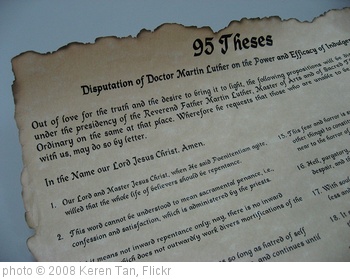
'Luther's 95 Theses' photo (c) 2008, Keren Tan - license: http://creativecommons.org/licenses/by-sa/2.0/(This is one of two Reformation Day posts I am republishing today. This one on the five solas of the Reformation is from 2012.)

Happy Reformation Day!

As evangelical Christians, we should rejoice in this day and what it represents. On Oct. 31, 1517, a Catholic monk named Martin Luther nailed his “95 Theses” to the church door in Wittenberg, Germany. That event helped set off the Reformation, which continued for decades and still affects us today. We will celebrate the 500th anniversary of this history-changing event in five years, God willing.

That reform came at great cost to Luther and many others, and we continue to benefit from their sacrifice and the truths they recovered, stood for and proclaimed. The issues that produced the Protestant and evangelical movements remain important today.

The truths of the Reformation are often summarized as the five solas. That word, sola, means “only” or “alone.” The five are: Scripture alone; Christ alone; grace alone; faith alone, and the glory of God alone.

The use of the word “alone” is important. For instance, the Roman Catholic Church did not deny Scripture had authority; it said Scripture was not the sole final authority.

I was reminded of the ongoing importance of the Reformation and its impact on our lives at a recent Capitol Hill briefing I covered as a news reporter. A panel of three evangelicals and a Roman Catholic gathered to discuss criminal justice in the United States.

One evangelical spokesman, a Southern Baptist, said early in his presentation, “Southern Baptists consider themselves people of the Book. Our question always first is: What does the Bible have to say about an issue?” The next speaker, also an evangelical, affirmed that view.

The representative of the U.S. Conference of Catholic Bishops followed and said, “[W]hile the Southern Baptists and evangelicals might be people of the Book, Catholics are people of the papal encyclical and the bishops statement.”

Many in the audience laughed, but that brief account demonstrated one of the differences that still remain between Protestantism and Roman Catholicism.

As we think about the Reformation ignited by Luther on this date 495 years ago, let us remind ourselves of these truths:

-- Scripture alone is our final authority, not Scripture plus an individual, council, church, tradition, experience or document.

-- Christ alone is our mediator with God, not Christ plus any human righteousness or accomplishment.

-- Grace alone is the way of salvation, not grace plus any human work or method.

-- Faith alone is the means of justification, not faith plus any human merit or infusion of Christ’s righteousness.

-- The glory of God alone is the purpose of life, not His glory plus that of any other.

As those saved by grace alone through faith alone because of Christ alone, may we hold onto these truths as we recognize our ongoing need for reformation in our own lives.