Tuesday, August 12, 2014

Preaching: 'A picture of the gospel'

I am grateful as a pastor when writers communicate eloquently the significance of preaching in the life of a church. David Mathis, executive editor of Desiring God, posted Sunday a profound piece – titled “When Grace Is in the Pulpit” -- on the proclamation of God’s Word and the church’s response to it.

As Mathis points out, preaching is not all there is by any means to corporate worship, but it is a vital part. He writes, “The other elements of the gathering follow the rhythm of receiving from [God] and responding back to him, but in preaching we move into the posture of simply receiving, whether it’s a full half hour or just 15–20 minutes.” Our congregation would add, “Or 45-50 minutes.”

You can read all of the post here, but I have pulled out some of Mathis’ comments below I think might be particularly help for a congregation:
When we put ourselves under the preaching of God’s word, it is one of the precious few moments in life today when we close our mouths, and confront the temptation of responding right away, and focus our energy and attention to hearing with faith.

The act of preaching itself is a picture of the gospel. As the preacher stands behind the Book, doing his level best to re-reveal Jesus to his people, our Lord is put on display, not for give-and-take and the mingling of our efforts together in some mutual enterprise. Rather, we sit in the seat of weakness and desperation. What we need is not some boost from a trusted fellow to get us over the wall, but the rescue of the Savior for the utterly helpless.

The best of preaching serves the worshiper in the joy of self-forgetfulness, and preacher-forgetfulness. Preaching that goes on and on about the preacher himself, or is always angling at how the hearer should apply this or that to daily life, does so at the expense of tapping into the very power of preaching, namely, a preoccupation with Jesus. True Christian preaching swallows up the listener again and again, not with self or the speaker, but with Jesus and his manifold perfections.

The great goal of preaching, as well as the sacraments and the various other spiritual disciplines, is this: knowing and enjoying Jesus. The greatest incentive for attentive listening as we gather for corporate worship and sit under the preaching of God’s word is that we may know him (Philippians 3:10).

Thursday, August 7, 2014

Are we remembering the persecuted saints?

As many as 40,000 of our fellow image-bearers remain stranded atop a mountain in northwest Iraq while we go about what can only be described by most of the world as comfortable, even luxurious, lives. If they remain on the mountain, they face death by dehydration. If they descend the mountain, they face death from Islamic militants.

Most of those stranded are Yazidis, a minority religious group in Iraq. Some reportedly are Christians. They fled to Mount Sinjar as the ruthless forces of the Islamic State of Iraq and Syria (ISIS) neared their homes. Some children and adults already have died from thirst. Some men and women did not escape execution and rape by the extremists.

Tens of thousands of other Iraqis also have become refugees to avoid ISIS’ murderous campaign. The mass exodus of Christians from Iraq – which is more than a decade old -- may be near its end game. An estimated 1.2 million Christians lived in Iraq before Saddam Hussein’s regime fell in 2003. Now fewer than 200,000 remain. ISIS drove all Christians from Mosul, the country’s second largest city, a few weeks ago. The militants are determined to rid the entire land of Christians and other religious minorities.

This is only the latest example of a sobering reality for followers of Christ: To be identified with Jesus is to invite mistreatment, imprisonment, torture and execution. An average of 180 Christians around the world are killed each month for their faith. Christians in more than 60 countries face persecution from their government or neighbors.

In response, we can feel powerless to help the people on Mount Sinjar or our fellow saints in not only Iraq but countries such as Iran, Pakistan, North Korea and Syria. We may viscerally react with grief and disgust at reports of atrocities, but we move on to more immediate concerns in our lives that we acknowledge pale in comparison. We may ask: What can we do?

Last Sunday, one of the young ladies in our church read aloud Heb. 13:3 before we prayed for persecuted Christians and others in need. That verse says, “Remember the prisoners, as though in prison with them, and those who are ill-treated, since you yourselves also are in the body.”

The context appears to indicate the writer is referring here to Christians who are imprisoned or mistreated. Certainly we should defend, care for and pray for any who are threatened or brutalized. But there is a special expectation that we, as followers of Christ, would remember our brothers and sisters in the faith.

How do we remember them? With the assistance of others, I offer these as some ways:

1. To remember a persecuted Christian is first to keep him or her in mind. The oppressed in other countries have testified one of their greatest burdens or fears is they would be forgotten during their suffering. We should not forget those who are enduring affliction on the basis of their identification with the same Savior with whom we are identified.

2. To remember a persecuted Christian is to identify with his or her suffering. Heb. 13:3 says we are to remember prisoners “as though in prison with them.” This verse seems to call for us to think about what it would be like to be a fellow prisoner with that saint. It also says we are to remember the mistreated since we also “are in the body.” That seems to mean we -- who also have a physical body and know something of what it means to be in pain – should identify in our bodies with the suffering of our brother or sister. We should take time to agonize with our fellow saint.

3. To remember a persecuted Christian implies we are to care for, help and tend to the needs of the one who is suffering. If we are near, it can mean visits to prison or caring for the family of the prisoner. If we are far away, it can mean writing or otherwise communicating with our fellow saint.

4. To remember a persecuted Christian is to pray for him or her. We remember that Christian to God. There is nothing greater we can do for a suffering saint than pray for God’s gracious provision in his or her life. We can pray for deliverance from persecution, as well as endurance during it. We can pray for a bold gospel witness by the persecuted and for the breaking up of the hard soil of the heart in the persecutor.

May we remember the persecuted, and may God prepare us for any persecution to come in our own lives.

Wednesday, July 16, 2014

Handling disagreements in the church (Part 1)

One of the many blessings of having our children become adults is to be able to worship with them and their churches when we visit them in cities far from us. We have been able to experience something of life in the churches they have joined and, in some cases, have come to know their pastors.

Our daughter and her husband have been members of the same church since shortly after they were married in 2005. Because our son is in the Air Force, his wife and he have been part of several churches as they have moved from station to station the last 11 years.

Now, the churches they are members of – another move just took our son and his wife away from their church home – are facing challenges. Disagreements mark both churches, though both are biblically faithful, gospel-focused bodies. The existence of these churches does not appear in question, but they now face the tests brought by divisions among saints.

This news has reminded me how vital it is for a church’s leaders and members to handle disagreements properly. After all, this is about the name of Christ and the witness of His body on earth.

Covenant Community Church knows something of this experience. Our church has experienced some painful differences in the last year. A theological disagreement – one the elders and a majority of members did not believe should divide us – nonetheless resulted in some members removing themselves from the church.

As a pastor, I look back at the departure of members with regret, sometimes realizing I could have handled issues better than I did. There have been times I should have addressed more quickly what appeared to be growing dissatisfaction on the part of some members. In at least some cases, I don’t think there is anything the other elders and I could have done to prevent the separation. I also recognize some members could have handled their concerns better than they did.

How should church members handle disagreements within their fellowship, regardless of the nature of those disagreements? Here are some of several recommendations I plan to share in this post and a sequel:

1. Make certain your differences count. Too many divisions in churches are based on things that really shouldn’t matter. Church members battle over the cosmetic appearance of a building. They fight over what style of music should be used in corporate worship. Members decide their felt needs are not being met. They get their feelings hurt over real or perceived slights. Those issues call for biblically based, grace-filled solutions, not acrimony and division. They also call for servanthood. All members, including elders, must remind themselves their purpose is to serve, not to be served. We are all followers of Jesus, the King of kings who came not to be served but to serve (Mark 10:45). What are issues, when properly understood, that may call for division? Certainly, the gospel and essential biblical doctrine are two of those.

2. Think, listen, speak and act with humility. Though we are saints, we all retain a sin nature that infects all we do. None of us perceives God, His Word or His people perfectly. We should remind ourselves regularly of these limitations as we dwell on how we disagree with other Christians – or think we disagree with other Christians -- and as we begin the process of expressing those disagreements. Disputes and divisions in a spirit of pride can make a recipe for personal disaster – and possibly corporate disaster. The apostle Peter says it well: “Clothe yourselves, all of you, with humility toward one another, for ‘God opposes the proud but gives grace to the humble’” (I Peter 5:5).

Wednesday, June 18, 2014

Fatherlessness and the church

'Father/Son A and B' photo (c) 2008, heymarchetti - license: https://creativecommons.org/licenses/by-sa/2.0/Sports columns aren't typically known for underscoring the importance of fathers, but then Rick Reilly's final column as a sportswriter wasn't typical. At age 56, the 11-time National Sportswriter of the Year opened his farewell column last week this way:
I am the son of a drunk, a man who was much too concerned with where his next whiskey was coming from than where I was going.

He didn't discipline me. Didn't advise me. Didn't father me. . . . [M]ost of the time he didn't even know where I was. And my trembling mother was much too terrified of him and his sloppy temper slamming home to worry about what I was doing.

So when I got a regular byline in the town paper before my 21st birthday, I was as wild and unruly as the mop of hair on my head. I had a voice and a license to use it, but not one lesson in how. I hurt people just to make a name for myself. Just because I could.

My first beat was the Colorado women's basketball team and I came out slashing. Until, one day, a retired coach named Sox Walseth came up to me. His hair was white, with matching caterpillar eyebrows, and he wore a cardigan. He put a hand on my shoulder and said, "Son, you're not going to get very far writing articles like the one you did today. These people shouldn't have to read the cheap shots you're taking at them. You can do better than this."

I looked right back at him, stuck out my bottom lip, and began to cry.

I was so starved for a father that this man I hardly knew was suddenly thrown into the job. I'm sure he was as confused about what was happening as I was, but he took me to his chest and hugged me.

As I sit here and write my last column as a sports writer, I see now how that moment changed my life.
It brought tears to my eyes as I read it. (That will not suprise my family.) Reilly's account demonstrates once again the kind of power the loving, faithful presence of a father or father figure can have, as well as the kind of power the unloving, faithless absence of a father can have.

A father can be either a bridge or a barrier to understanding God as Heavenly Father. It certainly is true in Christian homes. It seems as if it can be true even in non-Christian homes. It can be true both for sons and daughters.

Reilly's painful experience of the 1960s and 1970s has mushroomed into an epidemic of fatherlessness and father absence in America. An estimated 33 percent of American children live apart from their biological fathers, and that figure is expected to grow to 50 percent by the next century at the current rate. The fallout from this trend is well documented in a number of social indicators.

What does this plague of fatherlessness mean for the church? Well, of course, it is a reminder Christian fathers should be faithful and loving husbands and dads. But it means more than that. It means the adult men in our churches have the opportunity to be spiritual fathers to boys and girls, young men and ladies who have not known the love, acceptance and guidance they longed for from the men whose genetic makeup they share.

This will cost us as Christian men. It will cost the church. But isn't that what it means to be a Christian man? Isn't that what it means to be the church? After all, we follow the God who became man and served us at great cost to Himself. He suffered and died for spiritual orphans who had no loving father. May we die to our own interests and comforts in order to be the kind of father figures who can provide a bridge to our Heavenly Father.

Friday, June 13, 2014

Truth and grace on the transgender issue

'10070031' photo (c) 2012, moodboard - license: https://creativecommons.org/licenses/by/2.0/The transgender issue is quickly gaining attention in our culture. I addressed it when I began a preaching series titled "Gender, Sexuality, and the Purpose and Power of God" June 1. The text that morning, Gen. 1:26-27, says God made man -- which refers to human beings not just males -- in His image and closes with these words: "[M]ale and female He created them."

God has not changed. He still makes each of us either male or female. And we are to embrace how He has made us. Yet, as a race infected by sin, some people identify themselves as a gender different than their biological sex. As the transgender movement gains acceptance, increasingly confused children and adults find encouragement to believe they should live as a gender different than that given by God and even to change their bodies to fulfill that identity.

The Southern Baptist Convention, meeting this week in Baltimore, approved the first resolution in its nearly 170-year history specifically on the transgender issue. You can read the entire resolution here. It is a statement filled with both truth and grace:

-- It affirms gender "is determined by biological sex and not by one's self-perception."

-- It expresses "love and compassion" to people who struggle with a conflict between biology and gender identity.

-- It invites all transgender people to trust in Jesus and welcomes them "to our churches and, as they repent and believe in Christ, receive them into church membership."

-- It recognizes transgender people as image-bearers of God and denounces abuse directed toward them.

-- It also opposes efforts to change a person's "bodily identity" by gender reassignment surgery and other treatments.

I made some of the same points near the close of my June 1 sermon. Based on my manuscript, I put it this way:

1. We should not be surprised that such misguided thinking as that of transgender people is found in human beings. They, and we, live in a fallen world where the sin nature blinds us and causes us to believe lies. But we also should not surrender on this reality of Scripture and creation: God has made us male and female.

2. We should not see those who have what is described as a gender identity disorder as mutants or freaks. They, like all other human beings, are made in the image of God.

3. We should love, care for, serve, evangelize -- and hopefully -- disciple them. They, like all other sinners, need the gospel. And once they have received the gospel of Jesus, we should help them see, as Russell Moore has said, that part of repenting and following Jesus is not rebelling against their Creator but accepting the gender they were given by God.

Thursday, May 15, 2014

Why we sing in corporate worship

'St Ebbes 11:45 Service' photo (c) 2011, Jimmy and Sasha Reade - license: http://creativecommons.org/licenses/by-nd/2.0/(Here is an excerpt from a 2012 post on the church's singing in corporate worship.)

Christianity is a singing faith, and for that -- I think -- we should all be thankful. The Bible -- which governs how we worship -- calls for singing by God's people corporately in both the Old and New Testaments.

While more could be listed, here are some reasons Scripture indicates we should sing as a church:

(1) We should sing to give God glory.

"Sing the glory of His name; make His praise glorious" (Ps. 66:2). These commands from the psalmist are to all the earth, so it certainly applies to those who belong to God as His redeemed children. We give him glory in song by declaring how glorious He is and by making our praise of Him glorious.

(2) We should sing to declare God's attributes.

The same verse, Ps. 66:2, conveys this message by speaking of "the glory of His name." God's "name" in Scripture refers to who He is -- in other words, what His nature is, what His attributes are. The psalmist says God's people should make His attributes known in their singing.

(3) We should sing to proclaim the atoning death of Christ.

"And they sang a new song, saying, 'Worthy are You to take the book and to break its seals; for You were slain, and purchased for God with Your blood men from every tribe and tongue and people and nation. You have made them to be a kingdom and priests to our God; and they will reign upon the earth" (Rev. 5:9-10) The apostle John's vision showed those around the throne singing about the blood sacrifice of the Lamb of God and its far-reaching impact. We will sing as one great choir about the cross-work of Jesus one day in Heaven, and we can do it now corporately on earth as the church.

(4) We should sing to instruct and encourage one another.

"Let the word of Christ richly dwell within you, with all wisdom teaching and admonishing one another with psalms and hymns and spiritual songs, singing with thankfulness in your hearts to God" (Col. 3:17). Singing, as the apostle Paul explains, has a discipleship function during corporate worship. As we sing, we act as teachers and encouragers to those with whom we are worshiping. We should recognize our singing is for the building up of our fellow saints, and their singing is for our building up.

(5) We should sing to express our heartfelt affection to God.

In this same verse from Col. 3, Paul says Christians in worship should sing "with thankfulness in your hearts to God." In Eph. 5:19, he says believers are to be "singing and making melody with your heart to the Lord." Singing is a means of expressing ourselves to God. As we sing together corporately, we tell Him of our gratitude for what He has accomplished on our behalf and express to Him joyful affection for who He is and what He has done.

Friday, May 9, 2014

The resurrection and this perilous cultural moment

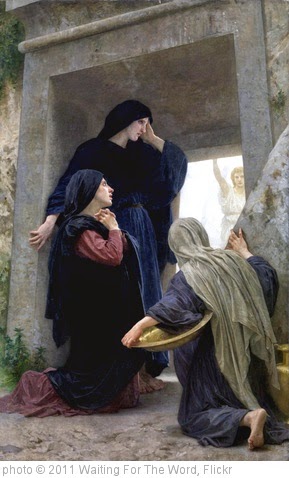
'Easter Morning 23' photo (c) 2011, Waiting For The Word - license: https://creativecommons.org/licenses/by/2.0/We – the church of Christ – celebrated the resurrection of our Lord the Sunday after I last wrote for this blog. That previous post focused on a discussion some of the Covenant Community Church family participated in the prior Sunday evening regarding the cultural moment we find ourselves in. It is a time of growing intolerance for the biblical view of marriage and for the freedom to express that view.

In the days since that post and Easter, I have thought about what the resurrection of Jesus has to do with how we approach the issue of society’s redefinition of marriage. My conclusion? It has a lot to do with it.

By God’s providence, I reached on Easter in my preaching series through I Corinthians that great chapter on the Resurrection, Chapter 15. I preached on the first 19 verses of that chapter on Easter Sunday. I plan to cover the remainder of the chapter this Sunday.

In I Cor. 15, the apostle Paul explains the indispensability of the resurrection. There is no gospel and there is no salvation without Jesus rising from the grave, he says. Paul continues through 58 verses informing the believers in Corinth about the significance and details of Christ’s resurrection and theirs. He points to the Lordship of Jesus over all things, including death.

Paul closes this magnificent and encouraging chapter by saying in the final verse: “Therefore, my beloved brethren, be steadfast, immovable, always abounding in the work of the Lord, knowing that your toil is not in vain in the Lord.”

Those are encouraging words for those who trust in a resurrected Lord and believe in the future resurrection of the body. In fact, we might call them “marching orders.”

After providing the most extensive biblical teaching on the resurrection, Paul urges his readers – saints whom he dearly loves – to not back down. Based on what he has written in the first 57 verses, he tells them to continue doing what they are doing. He exhorts them to remain faithful in doing what Christ has ordained for them to do.

How can Paul say this to those who were in a perilous cultural moment in the First Century and those who are in a perilous cultural moment in the 21st Century? He can say this because the resurrection of Jesus of Nazareth actually happened and our resurrection will actually happen. The resurrection of Christ changes everything for us. We no longer need fear anything, including persecution from a culture that opposes our beliefs. He also can say this because our work in His behalf – not to gain God’s acceptance but to live out the acceptance He has already granted us through the righteousness of His Son – will not be “in vain.”

To say our “toil is not in vain” is not to say we will see the fruit of those labors quickly or even in our lifetimes. But God’s words promise our labor will not be "in vain." For all who are in Christ, we can live with this assurance: Our toil on behalf of Christ and His gospel – a gospel that necessarily includes the resurrection – will be worthwhile. May we stand strong in this cultural moment with that certainty.